Stay up to date – you can subscribe to our newsletter here

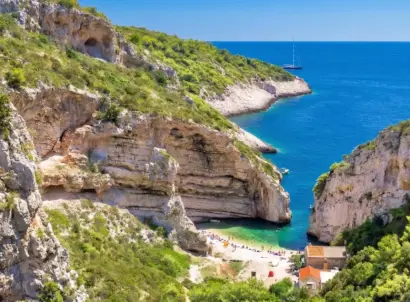
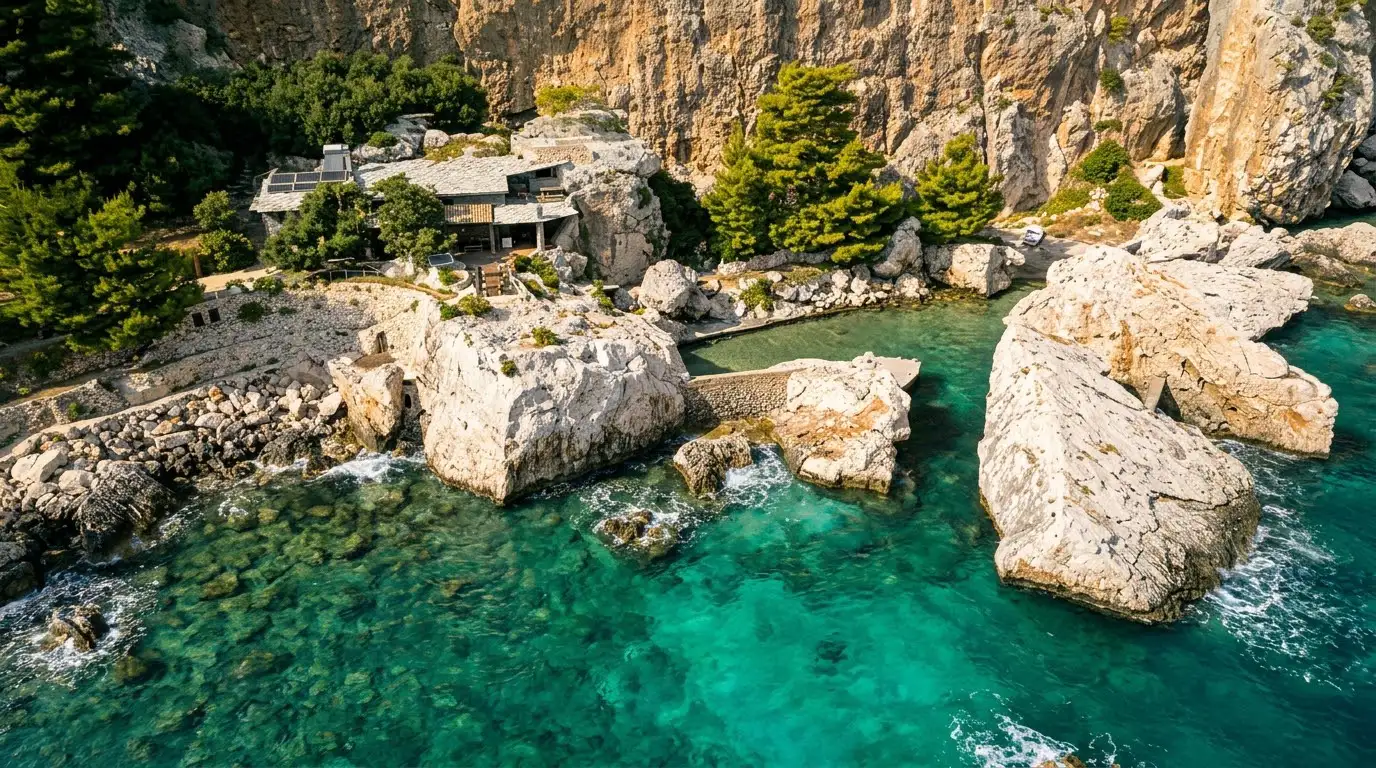
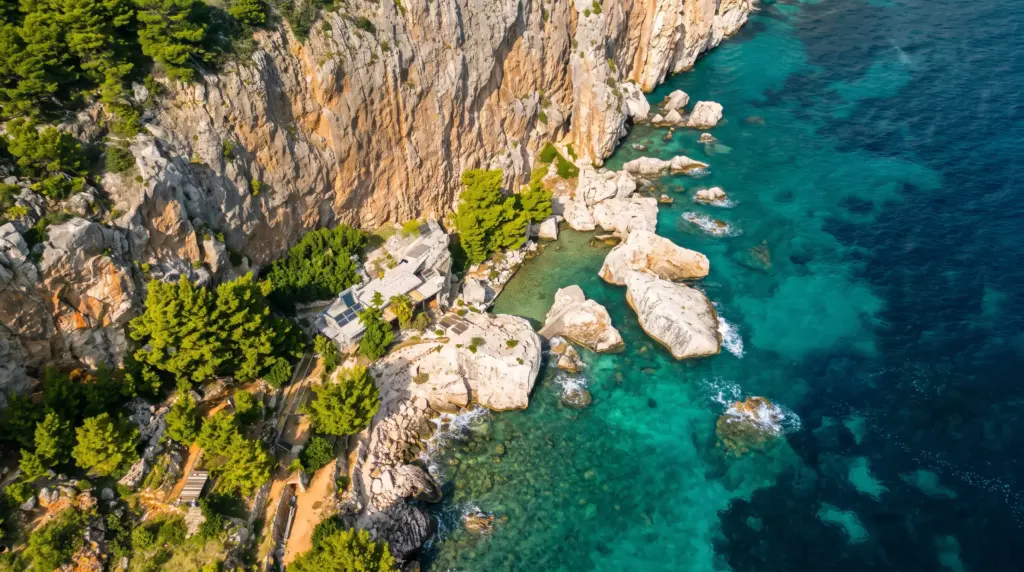
Anyone traveling along the south coast of the island of Hvar—whether by water or along the narrow coastal road—will discover, about 700 meters east of the small wine-growing village of Sveta Nedjelja, a place that looks like something out of an adventure movie. Directly below steeply sloping limestone cliffs, a rustic stone house clings to the rock, sheltered by massive boulders and a small lagoon in the crystal-clear sea, separated by a low wall. This is Cliffbase —also known in the original Croatian as Šuplja Stina.
A dream retreat right on the water
Behind this extraordinary spot is the Slovak climber Miroslav “Miro” Štec. To escape the hectic pace of his professional life, he found his personal refuge on the wild southern coast of Hvar, set up most of the climbing routes there himself, and, step by step, built a small, nature-oriented center.
To this day, Cliffbase does not follow a traditional resort model, but instead focuses on sustainability, seclusion, and simple authenticity. Right on the lagoon, there are a few simple places to stay—literally just a few steps away from the rocks and the sea. After a day of outdoor activities, Miro also invites visitors to his small rock-hewn wine cellar to sample his own organic olive oil and local Plavac Mali —the full-bodied red wine for which the steep southern slopes around Sveta Nedjelja are famous far beyond the island.

Sport climbing above the Adriatic Sea—and an important safety note
For years, Šuplja Stina was considered the best-known and most diverse sport climbing area on Hvar. The south-facing limestone walls right by the sea offer more than 100 routes—and, depending on how you count the sectors and variations, even more than 150—ranging in difficulty from about 5a to 8a. Typical features include steep, well-gripped lines, which share lengths of up to 40 or 45 meters and span more than two pitches in places. In the summer, when the sun beats down mercilessly on the south-facing wall, many climbers switch to deep water soloing (DWS) directly above the deep water or take advantage of the shaded sections in the late afternoon.
Important for planning: First, the core area of Cliffbase is located on private property—access is limited, subject to a fee, and requires prior registration with Miro (overnight guests are given priority and receive discounts or free access). Second, regional climbing portals and guidebooks (as of summer 2026) explicitly point out durability issues with the bolts due to the aggressive, salty sea air. The local portal hvarclimbing.com has therefore reported the Šuplja Stina area as closed until the renovation (rebolting) is complete. Anyone planning a trip specifically for rope climbing should definitely check the current condition of the routes in advance directly via cliffbase.com.
Via Ferrata Hvar: Across the Suspension Bridge Toward Sveti Nikola
Apart from the climbing area on the beach, Miroslav Štec and his team have created another highlight above Sveta Nedjelja: the Via Ferrata Hvar below the island’s highest peak, Sveti Nikola (628 meters). This small via ferrata park combines breathtaking views down over the vineyards and the Adriatic Sea with a culturally and historically significant descent.
An overview of the key facts about the via ferrata:
- Two route options: If you prefer something a bit more moderate, choose the Via Avalon (difficulty A/B, about 70 meters of elevation gain over a distance of 100 meters) along an easier ridge. The Via Mirko (B/C, 80 meters of elevation gain over 90 meters) is significantly more challenging; it leads upward via a steep initial staircase and handholds, with a nearly vertical and highly exposed ascent—here, sure-footedness and a head for heights are essential.
- Sveti Spiridion Bridge & Via Barbara: Both routes meet at the 30-meter-long Sveti Spiridion suspension bridge. From there, the Via Barbara (difficulty level B, approximately 200 meters of elevation gain) continues upward toward the summit plateau via secured passages and short walking sections.
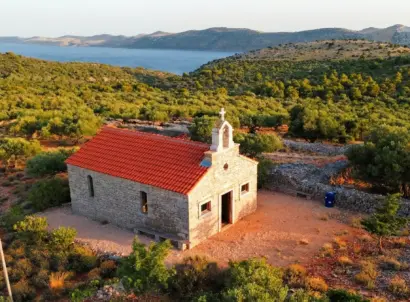
- A Historic Return Trip: The marked trail back down to Sveta Nedjelja takes about an hour and passes by the Gospa od Zdravlja Chapel and the impressive Spilja Sveta Nedjelja cave, which contains the remains of a 16th-century Augustinian monastery.
- Duration & Equipment: Plan on spending about 2.5 to 3 hours for the entire route. A via ferrata set and helmet are required and, like guided tours, can be booked directly through Cliffbase; a small fee is collected on site to help maintain the facility.
Getting There by Land and Sea: What Visitors and Skippers Should Know
Precisely because Sveta Nedjelja is located on the rugged southern side of Hvar, your trip there should be well planned—whether by car, on foot, or by boat:
- By car: The usual route leads from the Stari Grad ferry terminal toward Jelsa, then on to Pitve and through the narrow, single-lane tunnel to the south coast, passing through Zavala, Ivan Dolac, and finally Sveta Nedjelja. We advise against taking the direct, unpaved gravel road that branches off from the tunnel entrance between Hvar Town and Stari Grad—it is extremely narrow and runs along steep cliffs without any safety barriers.
- On foot from Sveta Nedjelja: From the small port in Sveta Nedjelja, a path about 700 meters long leads eastward along the coast directly to Cliffbase. The hike takes about 10 to 15 minutes, but involves scrambling over uneven, sometimes steep boulders—it’s best to leave your flip-flops in your backpack.
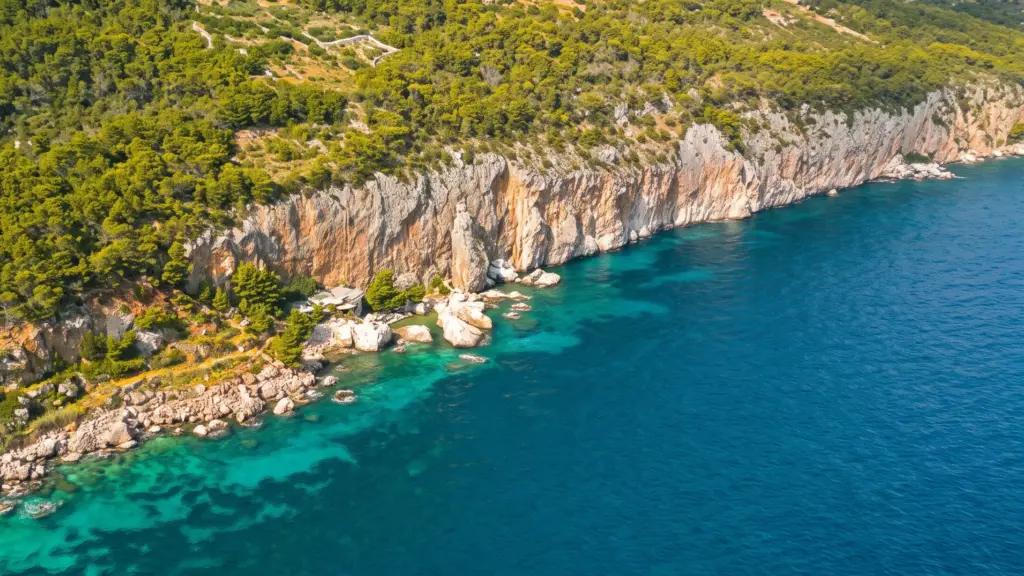
- By boat: From the water, the coastline off Šuplja Stina offers a spectacular backdrop, but this stretch is challenging from a nautical perspective. Directly in front of Cliffbase, there is no sheltered anchorage in swells or south winds (Jugo), and space is also very limited in the tiny port of Sveta Nedjelja—the small pier at the Plenković Winery (Zlatan Otok) can accommodate only about five boats. For a day trip in calm weather, a short water taxi ride from Sveta Nedjelja or a leisurely swim stop are good options; for a peaceful night at anchor, however, we make the recommendation to take the short sail across to the opposite island of Šćedro, part of the nature park, with its deeply indented, well-sheltered bays.
Contact and Best Time to Visit
Spring (March through May) and fall (September through October) are ideal for outdoor activities around Cliffbase and the via ferrata. In midsummer, the south-facing limestone walls heat up extremely during the day, so climbing trips are best done early in the morning or in the late afternoon. Anyone planning a visit, renting via ferrata gear, booking accommodation at the Lagune, or attending a wine tasting should always register in advance—by phone at
+385 91 764 8182, by email at [email protected], or via cliffbase.com.
Cliffbase is not a destination for spontaneous mass tourism, and that is precisely what makes this place so appealing. Where else on the Adriatic do wild, unspoiled coastal cliffs meet via ferrata adventures, a hidden stone lagoon, and handcrafted Plavac Mali? If you respect the local rules, check the current status of the climbing routes in advance, and keep an eye on the weather along the exposed southern coast, you’ll experience one of Dalmatia’s most unique and impressive spots at Sveta Nedjelja.