

Stay up to date – you can subscribe to our newsletter here

In late November, there’s a very special scent in the air along the Croatian coast—and, surprisingly, it has very little to do with the Adriatic Sea. When Split’s top restaurants kick off their traditional cod weeks—such as the renowned Kadena restaurant, which runs from November 27 through the end of December—locals know right away: Advent has begun. There, Chef Mate Brković serves the dried winter fish in six different variations—ranging from classics like pâté and doughnuts to gnocchi, rigatoni, and lasagna with red cod.
For many tourists on vacation in Croatia—who get to know the country mainly in the summer through grilled sea bream, branzino, and fresh calamari—this winter culinary ritual is a bit of a mystery. Why is it that a nation with one of the Mediterranean’s most fish-rich coastlines, of all places, swears by a dried fish from the freezing North Atlantic at Christmas?
A Shipwreck Marks the Birth of a Tradition
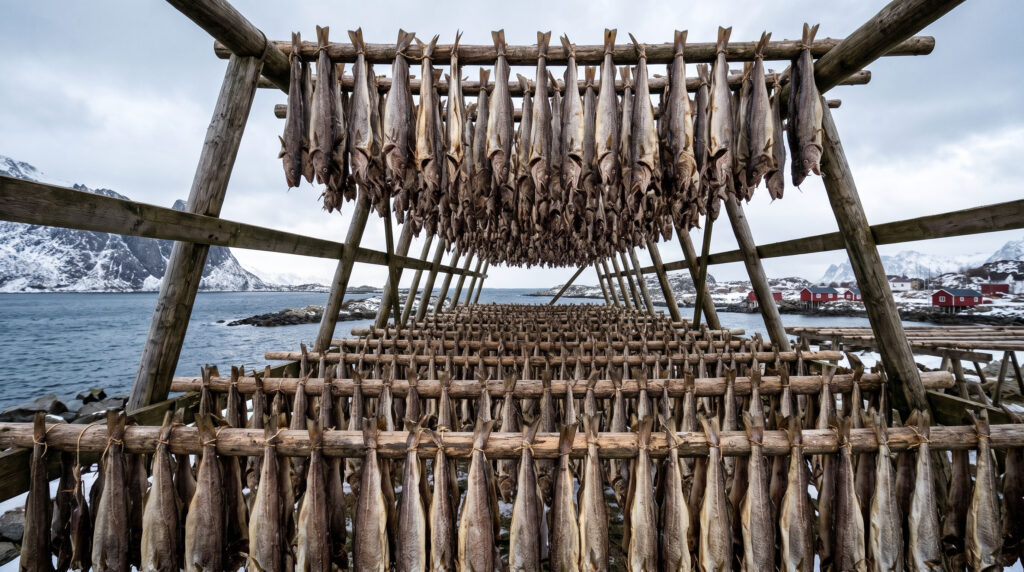
The history of Croatian bakalar (stockfish) does not begin in Dalmatia, but in the far north—and it owes its origins to a historical coincidence. In 1431, the Venetian merchant and nobleman Pietro Querini encountered a severe storm while on a trading voyage to Flanders. His ship drifted northward for weeks, unable to maneuver, until the surviving crew beached itself on the small island of Røst in Norway’s Lofoten archipelago in early 1432.
The local fishermen rescued the Venetians and fed them for months with cod dried in the Arctic air. Querini was so impressed by the shelf life and nutritional value of the unsalted dried fish that he brought back an entire shipment of it when he returned to Venice.
Since large parts of Istria and Dalmatia were under Venetian rule at the time, this northern fish quickly found its way across the Adriatic. The decisive breakthrough finally came with the Council of Trent in the mid-16th century: The Catholic Church reaffirmed strict days of fasting on which meat was forbidden—especially on Fridays, during Lent, and on Christmas Eve. Air-dried cod was the perfect solution. It didn’t spoil, was easy to store and transport, and for centuries was so affordable that it was considered a typical poor man’s meal.

Three Days of Patience: The Ritual Before Cooking
Anyone preparing authentic sušeni bakalar (air-dried cod) in Dalmatia or Istria today needs one thing above all else: time. When raw, the dried fish is rock-hard and looks more like driftwood than a delicacy.
Before it even goes into the pot, the traditional ritual begins:
- Tenderizing: In the past, the dried fish was pounded vigorously with a wooden mallet to loosen the tough fibers.
- Soaking: The cod is then left to soak in cold water for two to three days, with the water changed at least twice a day. During this process, it swells and regains its tenderness.
- Cooking and Flaking: After cooking, the fish is carefully deboned and skinned—the flavorful cooking liquid is absolutely essential and must be reserved as a valuable base.
At the very latest when it’s being cooked, that unmistakable, intense aroma fills the air—one that divides opinion: For some, it’s a smell that takes some getting used to; for most Dalmatians, it’s simply the scent of home and Christmas.
White or Red? Croatia’s Two Major Schools of Thought
Much like the debate over the best olive oil, almost every region—and every family—in Croatia has its own philosophy on how to serve the perfect bakalar. Basically, two preparation methods dominate:
| Preparation | Region & Focus | Character & Ingredients |
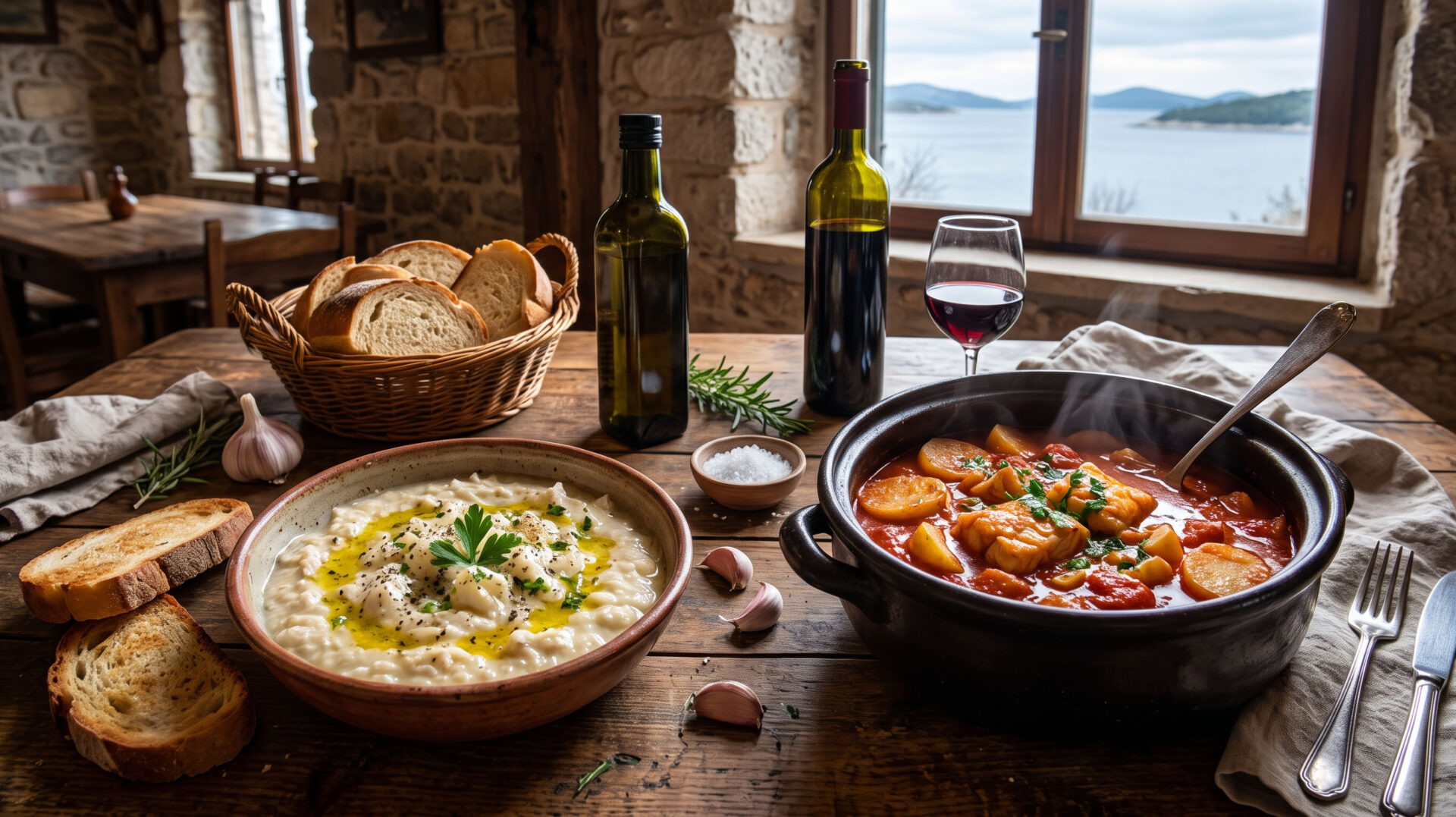
| Bakalar na bijelo (in bianco) | Istria, Kvarner, and also Dalmatia | A creamy spread or fine purée made from flaked cod, plenty of cold-pressed olive oil, garlic, parsley, and pepper—with or without potatoes, depending on the recipe. Often served on toasted bread. |
| Bakalar na crveno (na brudet) | Classic Dalmatia | A hearty stew made with cod, sliced potatoes, onions, garlic, olive oil, white wine, tomato paste or passata, and bay leaves. The pot is never stirred while simmering; instead, it is gently swirled. |
In addition to these classics, Croatian chefs are getting increasingly creative with this traditional fish in December—as shown by the current example from Split, where, in addition to white cod, they serve pâtés, crispy doughnuts (uštipci), and pasta dishes with red bakalar.
Badnjak: Community Gathering Around the Big Pot
The cod season reaches its absolute peak on Badnjak, December 24, as well as on Good Friday (Veliki petak). On Christmas Eve, bakalar is a staple of lunch or dinner in nearly every household along the coast before the midnight Mass (Ponoćka).
But this tradition has long since moved beyond the confines of the kitchen. In many cities along the Adriatic—from Split to Šibenik and Zadar to Dubrovnik—the main squares and waterfront promenades are transformed into huge open-air kitchens on the morning of December 24. Local chefs, clubs, and communities prepare thousands of servings of bakalar in massive cauldrons and distribute them free of charge to residents and visitors. Over a glass of red wine, Christmas carols, and relaxed conversation, people here experience what makes winter on the Adriatic so special.
From a Poor Man’s Meal to an Expensive Delicacy
However, a small paradox accompanies the tradition anew every year: what was once a dish for ordinary people has long since become a costly indulgence. High-quality, air-dried Norwegian cod of the highest grade now commands impressive prices per kilogram on Croatian markets and in specialty stores, often ranging from 40 to over 60 euros.
This regularly sparks discussions at the market stall in the run-up to Christmas and leads some households to opt for cheaper alternatives such as salted cod (slani bakalar) or frozen fillets. For purists, however, this remains a compromise—because only the original from the far north can bring the true, unmistakable taste of a Dalmatian Christmas to the table.
Anyone who visits Croatia during Advent—outside of the beach season—shouldn’t miss out on this slice of culinary history. Whether in a cozy konoba, at one of the large cod-sharing gatherings on Christmas Eve, or in a restaurant’s winter garden overlooking the tranquil winter Adriatic: a plate of steaming bakalar tells you more about the soul of the coast than any travel guide ever could.
