Stay up to date – you can subscribe to our newsletter here

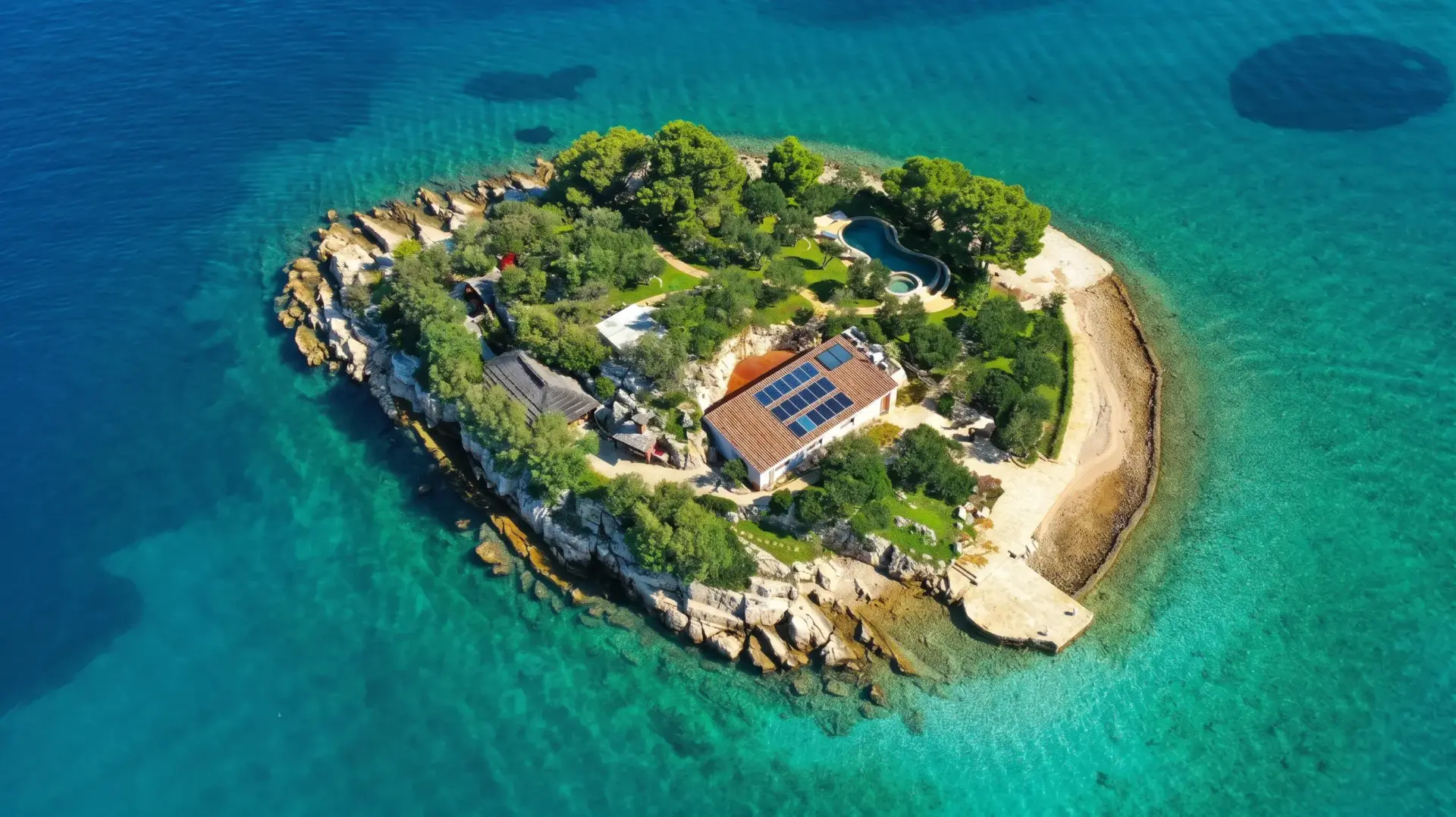
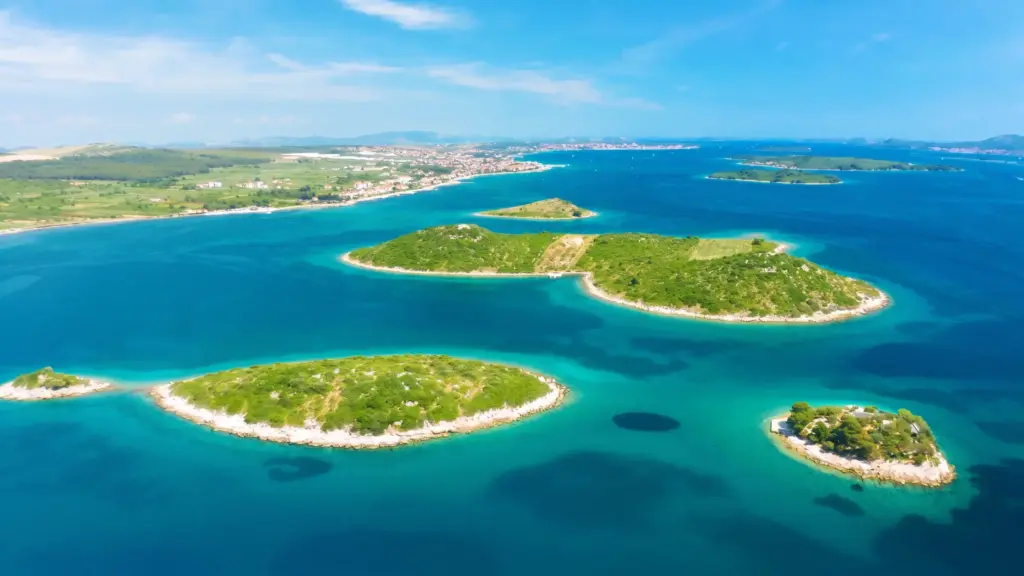
Anyone gliding through the Pašman Channel by boat will almost automatically find their gaze drawn to Galešnjak —the world-famous heart-shaped “Island of Love.” But just a stone’s throw northwest of it lies a tiny islet that, at first glance, looks like a Mediterranean dream: densely covered with pine trees, surrounded by turquoise-blue shallow waters, and crowned by a stylish natural-stone villa. Bisaga Mala —usually simply called Mala Bisaga —is barely larger than half a soccer field, yet in this tiny space it brings together two facets of the Croatian Adriatic: international ultra-luxury and one of Dalmatia’s most bizarre tales of unauthorized construction and “Pomorsko dobro.”
Tiny on the nautical chart, huge in the glossy brochure
Geographically, Mala Bisaga belongs to the municipality of Pašman and is located in the middle of the Pašman Channel—about 100 meters from its uninhabited “big sister,” Bisaga Vela, 170 meters from Galešnjak, and about 1.1 kilometers from the mainland near Turanj. According to official data from the Croatian Islands Program, the islet has an area of exactly 3,298 square meters, a coastline of 214 meters, and a maximum elevation of seven meters.
This makes it all the more amusing to take a look at the international real estate portals where the islet is being marketed to affluent buyers. Sometimes, the private land area in real estate listings is realistically stated as about 2,192 square meters, including a 103-square-meter villa; other times, in older listings, the island’s size swelled to 5,000 square meters—and international luxury real estate agents unhesitatingly turn that into a whopping 1.8 hectares.
On platforms featuring exclusive private islands, Mala Bisaga is marketed as the ultimate retreat for up to six or seven guests. The amenities read like something out of an architecture magazine: three bedrooms, a spacious stone terrace with an infinity pool and jacuzzi, a large solar panel system on the roof, a private chef upon request, and an in-house boat with a skipper that ferries guests from the mainland in twelve minutes. However, the price for this secluded tranquility is steep: on international luxury travel sites, rates start at over 7,200 euros per night.

Concrete, excavators, and seven years on the back burner
Behind the immaculate postcard-perfect facade, however, lies a story that made headlines in the Croatian media for years—and serves as a prime example of just how difficult it can be to protect the public coastal strip (Pomorsko dobro) along the Adriatic Sea.
In the land registry, the parcel was listed as pastureland (pašnjak) with a 103-square-meter farm building. The municipality of Pašman made it clear to journalists that there are no building rights on the island, no corresponding development plan exists, and no concessions have been granted for the coastal area. Nevertheless, as early as 2012, the Administrative Court ruled in a final judgment that the owner must remove the illegal structures and restore the island to its original condition.
After that, exactly one thing happened: nothing. The ruling lay unnoticed in some government drawer for seven years. It wasn’t until the summer of 2019 that observant boaters and readers of the Morski.hr website sounded the alarm again after excavators, debris, and construction materials suddenly appeared on the tiny islet. Through landfills and the concreting of the entire coastal strip, the small island was literally enlarged piece by piece through artificial means. Even the harbour master of Zadar, Alen Rukavina, confirmed at the time, with some irritation, that his agency had already documented the destruction of the coastal strip ten years earlier, but that the wheels of bureaucracy had ground to a halt afterward.
In February 2020, the preliminary legal bombshell finally came: The then-owner, along with three other individuals, was temporarily arrested on charges of destruction of public maritime property (devastacija pomorskog dobra) and fraud.
“Private and under video surveillance”—right on the public shoreline
Anyone who thought this would bring an end to the turmoil was proven wrong in the summer of 2021. Signs reading “Privatno i pod video-nadzorom” and English-language notices stating that the island was private and entry was prohibited promptly appeared along the concrete shoreline of Mala Bisaga.
For skippers and Croatia experts, this is a classic cause for outrage: Even if the interior of an island is privately owned, the immediate coastal strip in Croatia—known as “Pomorsko dobro” —belongs to the public and may not be cordoned off or privatized without a valid permit. When, in the spring of 2024, allegedly illegal construction work on a dock was uncovered on the famous neighboring island of Galešnjak, Mala Bisaga once again served as a cautionary example in the Croatian media of how pristine islets in the Pašman Channel are being turned into private concrete bastions.
Mala Bisaga at a Glance: Information for Skippers
- Location & Coordinates: Pašman Channel, Northern Dalmatia
- Size: 3,298 m² area, 214 m coastline, 7 m maximum elevation
- Neighboring islands: 100 m to Bisaga Vela, 170 m to Galešnjak, 1.1 km to the mainland
- Anchoring & Mooring: You can anchor beautifully all around the island and in the turquoise-blue channel between Bisaga Vela and Galešnjak, where water depths range from 2 to 7 meters; mooring directly at the Mala Bisaga dock is prohibited by the operators
- Risk of confusion: In Northern Dalmatia, three islets bear this name—in addition to Bisaga Mala in the Pašman Channel, described here, there is also a Bisaga Mala near Žut and Golić (Bisaga Mala) in Kornati National Park
Mala Bisaga is thus far more than just a pretty backdrop in drone photos of Galešnjak. From the water, the passage between the Bisaga Islands and the Island of Love remains one of the most photogenic spots in the entire Pašman Channel —and you certainly don’t need 7,200 euros a night to drop anchor here, jump into the crystal-clear water, and relax in your own cockpit while taking in the Mediterranean spectacle.