Stay up to date – you can subscribe to our newsletter here

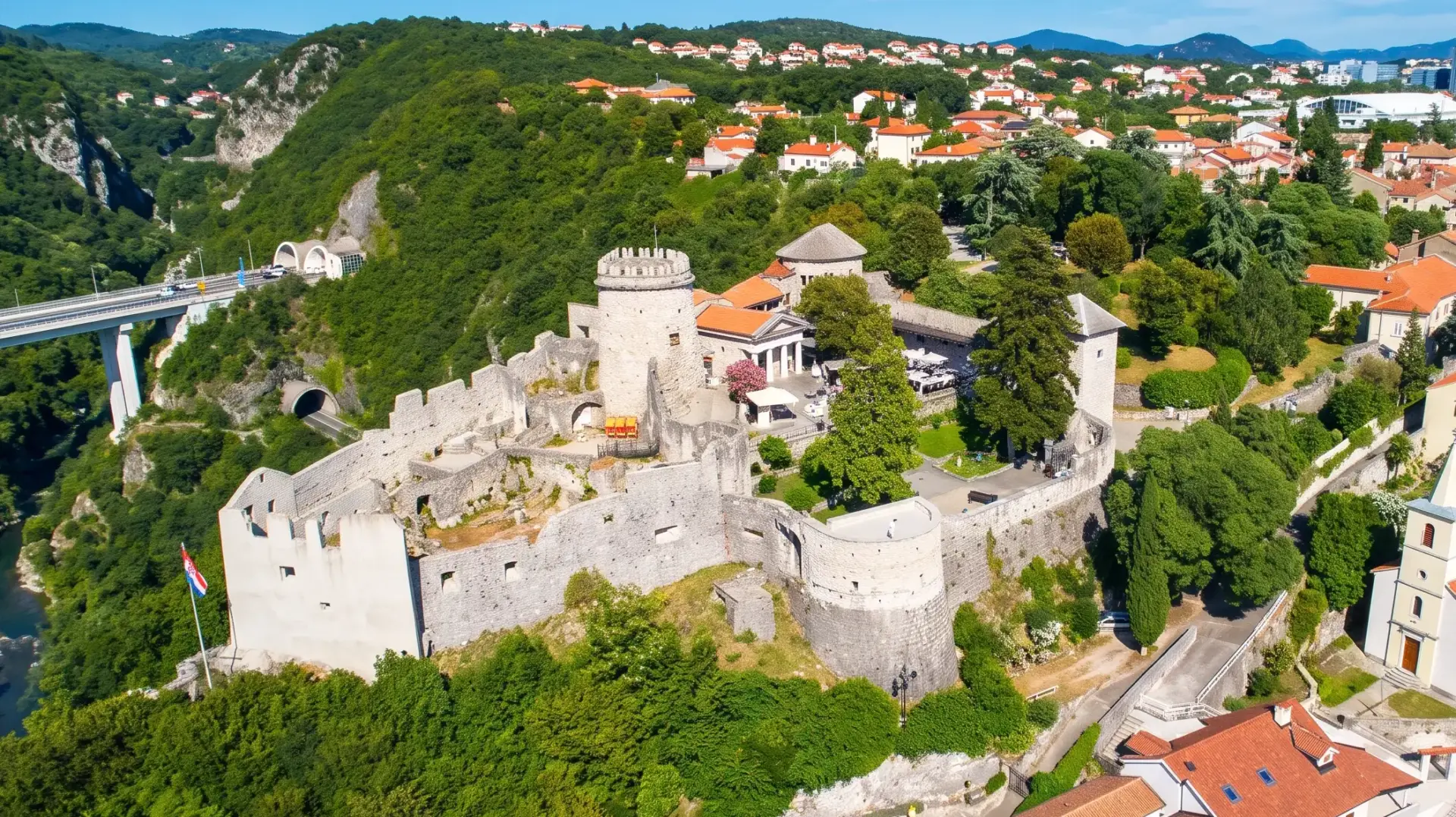
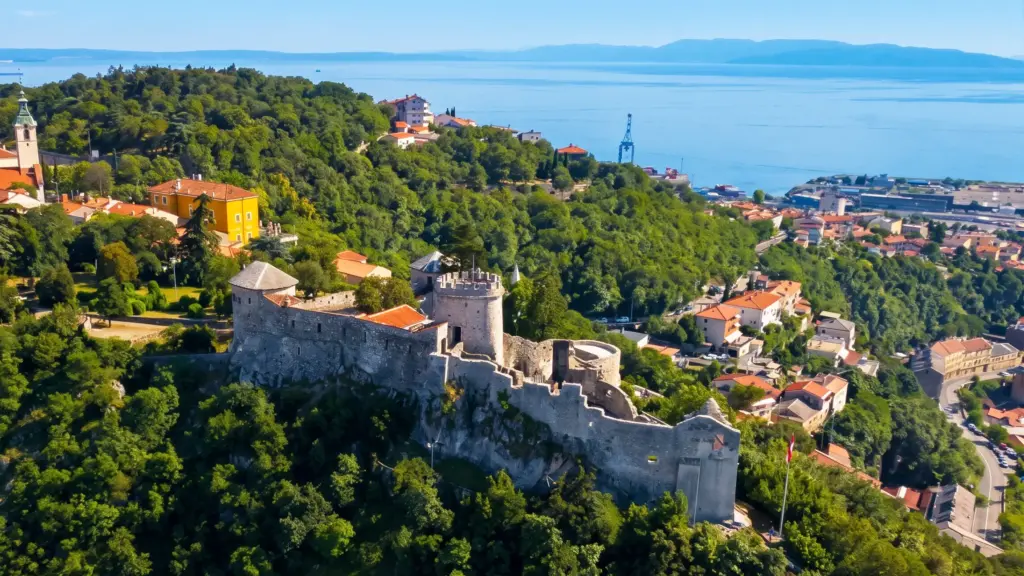
High above the deeply carved gorge of the Rječina River, on a 138-meter-high hill, stands Trsat Castle (Trsatska gradina). Anyone visiting Rijeka or stopping here on the way to the Kvarner Islands and Dalmatia should not miss this place: The fortress combines more than seven centuries of Croatian-Austrian history with what is arguably the most impressive panoramic view of the port city, Kvarner Bay, and the Učka Mountains.
From a Roman Watchpost to a Frankopan Stronghold
The strategic importance of the hill was recognized as early as prehistoric times. Long before the current walls were built, first the Illyrian Liburnians and later the Romans controlled the important route connecting the interior to the sea—at that time as part of the late-antique defensive system Claustra Alpium Iuliarum above ancient Tarsatica.
The fortress took on its current basic form in the first half of the 13th century under the powerful Frankopan princes of the island of Krk. Trsat is first mentioned in a document as early as 1288 in the famous Vinodol Code. For more than two centuries, the Frankopans held this strategically important fortress before it fell to the Habsburgs at the end of the 15th century. However, with the end of the military threat from Venice and the Ottoman Empire, the castle lost its significance. After the devastating earthquake of 1750, it was abandoned—for decades, ivy overgrew the crumbling walls, which the locals derisively referred to as “Drtine” (ruins).

Count Laval Nugent and the “Peace of the Heroes”
Rijeka owes the fact that Trsat Fortress has been preserved to this day in its distinctive Romantic style to a colorful Austrian field marshal of Irish descent: Count Laval Nugent of Westmeath. In 1826, he acquired the ruins and had them extensively restored—this is considered one of the earliest examples of historic preservation of medieval architecture in present-day Croatia.
Nugent, who had liberated Rijeka from Napoleon’s troops in 1813 and was closely associated with the Croatian cultural movement known as Illyrianism, established Croatia’s first museum in the castle. He also had a Neoclassical family mausoleum built in the heart of the complex. Above the portal, the inscription still reads today “Mir junaka” (“Peace to the Heroes”), beneath which the count rested for nearly a century after his death in 1862, before the crypt was cleared in the 1960s as part of a controversial renovation.
The Dragon of Trsat: Work of Art and Folk Legend
Among the castle’s most famous photo subjects are the bronze dragons of Trsat (Trsatski zmaj)—strictly speaking, basilisks with serpentine bodies, wings, and rooster heads. The sculptures were created in the 19th century by the Austrian sculptor Anton Dominik Fernkorn, inspired by the Nugent family’s heraldic animal.
The residents of Rijeka quickly wove their own legend around the striking bronze figures: It is said that a good-natured dragon once lived in a cave above Trsat, watching over the city. When, on the banks of the Mrtvi Kanal, a giant octopus emerged from the depths of the Kvarner Bay and lunged at the mayor’s young daughter, the dragon rushed into battle, saved the child, and hurled the sea monster far into the hinterland. After that, he vanished without a trace. Out of gratitude, the girl’s father had the bronze statues erected on the castle so that they might preserve the peace of Rijeka forever. The story remains so popular in Croatia to this day that the Croatian National Bank dedicated its own gold and silver collector’s coins to the Dragon of Trsat in 2024.
561 steps up—and what awaits at the top
The most atmospheric route up to the castle hill begins right in the center of Rijeka at the Petar Kružić Stairs (Stube Petra Kružića). In 1531, the Croatian captain and defender of Klis donated the first 118 steps to make it easier for pilgrims to climb to the nearby Marian shrine. After several expansions, the staircase now has exactly 561 steps —a roughly 20-minute walk, at times quite strenuous, through Baroque archways and past small votive chapels. Incidentally, a local anecdote claims that the devil, out of spite for the Franciscans, jumbled up the steps, which is why, supposedly, you never get the same result twice when counting them.
Once you reach the top, it’s worth taking the time for more than just a quick snapshot:
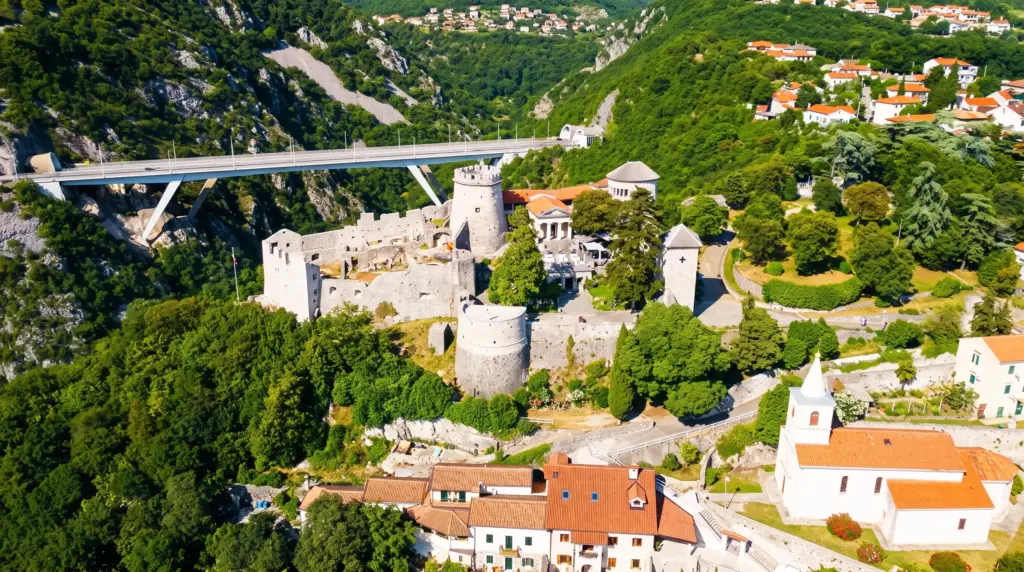
- The Roman Tower (Rimska kula): From the highest point of the fortifications, the 360-degree view stretches from the container port of Rijeka, past Opatija, all the way to the islands of Krk and Cres—and inland directly to the dramatic Rječina Gorge, complete with its striking highway bridges and tunnel portals.
- Putovima Frankopana Interpretation Center: The fortress is part of the “In the Footsteps of the Frankopans” cultural route. In the small visitor center, you can immerse yourself in the history of this noble family through multimedia exhibits.
- Coffee Break in the Castle Courtyard: The Vintage Bar, located right inside the historic walls, serves coffee and cold drinks in what is arguably one of the most relaxed settings in the city.
- Explore the neighborhood: Right below the walls stands the small white parish church of St. George (Crkva sv. Jurja), and right next door, the shady Nugent Park invites you to take a breather. Just a five-minute walk away lies the Basilica of Our Lady of Trsat, along with the Franciscan monastery—Croatia’s oldest Marian pilgrimage site.
A Fortress for Every Season
Unlike many historic fortresses, Trsat Fortress is not merely an open-air museum, but a vibrant gathering place for the people of Rijeka. In the summer, the event series Ljeto na Gradini transforms the castle courtyard into an open-air stage for concerts, theater performances, and DJ sets under the stars.
A real highlight, however, awaits during the cold season: With Zima na Gradini (the festive lights go on at the end of November), the entire fortress shines with the glow of thousands of lights as part of Rijeka’s Advent celebrations. With mulled wine, fritule, and a view of Rijeka illuminated at night, Trsat has long been considered one of the most atmospheric Advent destinations in the entire country—and admission is free.
Practical Information for Visitors
| Information | Details |
| Address | Partizanski put 9A, 51000 Rijeka |
| Getting There on Foot | Via the Petar Kružić Stairs (561 steps, approx. 20 min. from downtown) |
| Public Transportation | City bus line 2 (trolleybus) from the city center to the Trsat Crkva stop (about a 3-minute walk to the castle) |
| Getting There by Car | About 10 minutes from downtown; parking available around Nugent Park and Ulica Petra Zrinskog (arrive early during peak season) |
| Admission (Mon–Sat, 9:00 a.m.–5:00 p.m.) | April 1–Sept. 30: €3.00 adults / €1.50 reduced rate (children ages 7–18, students, seniors) / €8.50 family ticket Oct. 1–March 31: €2.00 adults / €0.50 reduced / €4.50 family ticket Children under 7 free |
| Free admission | Daily after 5:00 p.m., all day on Sundays, and during the Advent season (Zima na Gradini). The castle courtyard remains open until evening during restaurant hours. |
| Recommended duration | 60–90 minutes for the fort; 2–3 hours including the pilgrimage church, park, and coffee break |
Anyone who has known Rijeka only as a stopover on the way south or as a ferry and industrial port will quickly learn otherwise on the hill of Trsat. By late afternoon at the latest, when the sun hangs low over Kvarner Bay, the light bathes the ancient Frankopan walls in a warm glow, and the city lights begin to come on down in the valley, one of the most impressive aspects of the Croatian coast reveals itself here.