Stay up to date – you can subscribe to our newsletter here

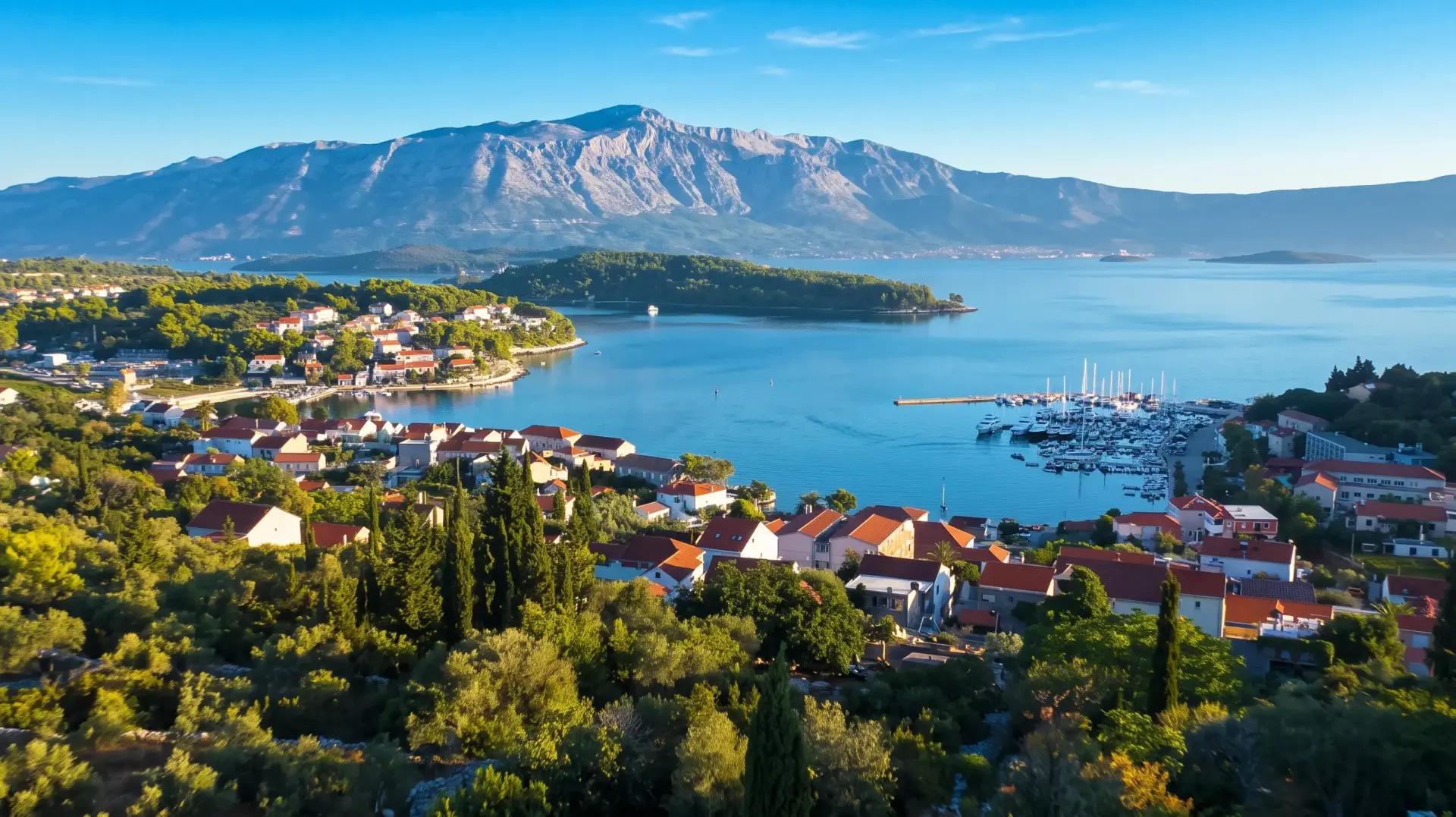
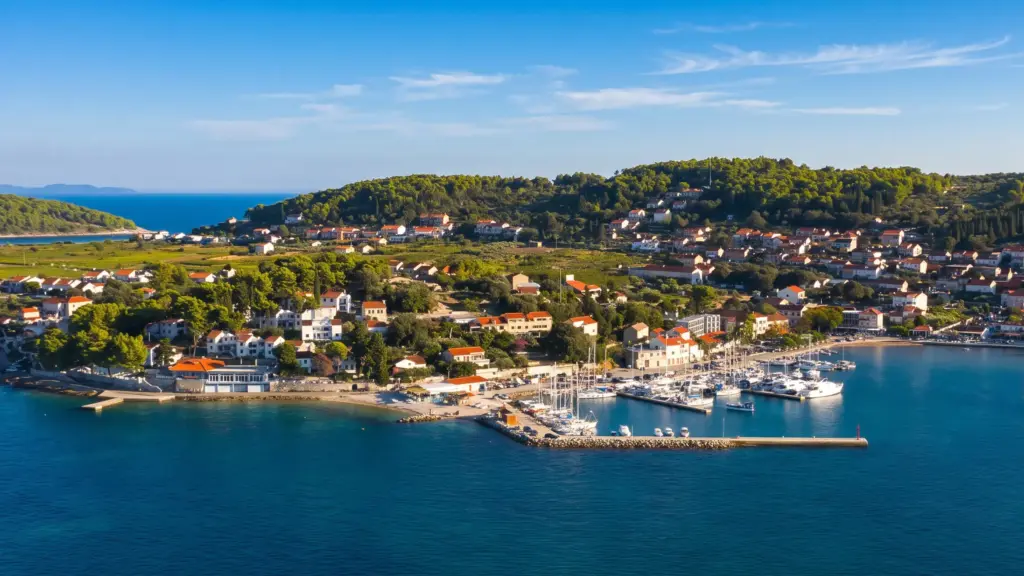
Anyone strolling today through the vineyards and olive groves and along the bays of Lumbarda on the eastern tip of the island of Korčula would hardly suspect how many millennia of history they are walking upon. In the fall of 2026, archaeologists made a series of extraordinary discoveries here: from a monumental stone sarcophagus between two konobas to a Bronze Age grave dating back some 3,500 years, as well as new evidence of Greek settlers both on land and underwater.
The excavation campaign conducted in September and October 2026 by the Center for Prehistoric Research, led by Prof. Hrvoje Potrebica (with deputy directors Miro Vuković and Milo Erceg), impressively demonstrates how many chapters of Dalmatian prehistory still lie hidden beneath stone piles, ancient paths, and the seabed. The findings were published in late November 2026 by the local association Lipa Rič Lumbarda.
Javič: One of the island’s largest stone burial chambers—right between two restaurants
One of the most spectacular discoveries was made at the Javič site, where researchers examined two prehistoric stone mounds (gomile), J1 and J3. Mound J3 lies beneath a large tree between two taverns—in a location that had been severely degraded over decades by waste dumping, fire pits, and the quarrying of stone.
The surprise was all the greater when a stone burial chest measuring 67 × 132 centimeters was uncovered beneath the damaged layers. It is one of the largest burial chests ever discovered in Lumbarda and on the entire island of Korčula. Although the lid slabs were broken and parts of the grave had already been cleared out in the past, more than a third of the original contents remained intact. Inside, archaeologists found well-preserved human bones as well as numerous ceramic fragments. Scientific laboratory analyses will now determine the exact age of the burial.
On the neighboring hill, J1, however, the dark side of human intervention became apparent: beneath the gravel and displaced stones, the team found nothing but bare rock. However, conversations with locals provided a valuable clue about the area’s history—it is said that an open stone chest containing visible bones once stood exactly there, which was presumably removed during road construction. Its whereabouts remain unknown to this day.

Krmača: A Bronze Age Monument with Multiple Construction Phases
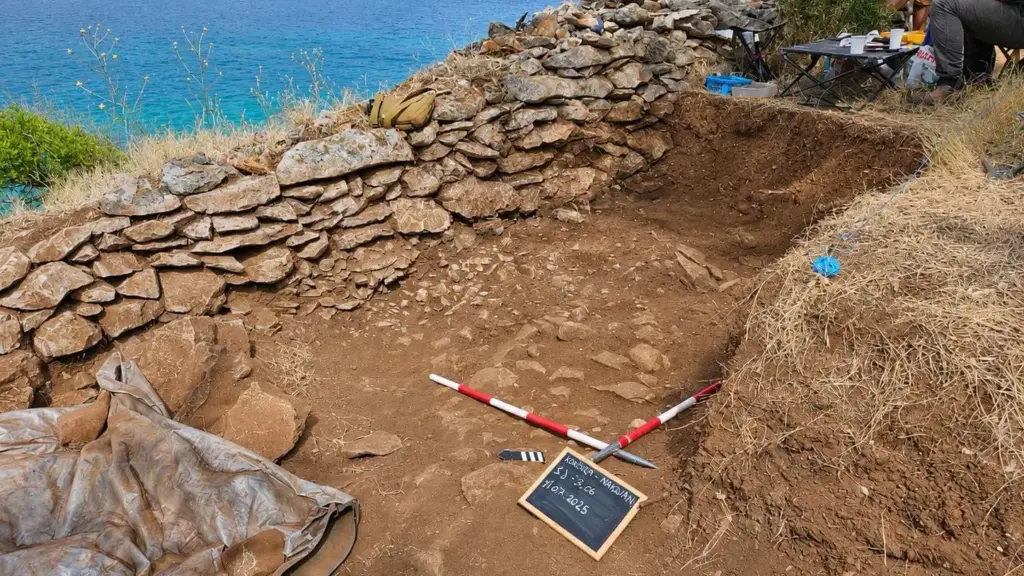
Another key part of the campaign was the completion of the multi-year excavations at Krmača, which had begun back in 2016. By examining all layers down to the bedrock, the archaeologists were able to precisely reconstruct the history of this approximately 3,500-year-old Bronze Age burial mound (ca. 15th century B.C.).
The burial mound was not created in a single step, but rather in clearly distinguishable phases:
- First, the builders constructed a central dry-stone tomb.
- A mound of earth was piled on top of it.
- Finally, they covered the structure with several layers of stones of varying sizes.
In addition to Bronze Age pottery and bone fragments, the team also uncovered marine shells that provide insights into the burial rituals of that time. Modern analyses will now follow: Radiocarbon dating (C-14) will determine the exact age, while strontium isotope analyses can reveal where the buried individuals came from and how mobile they were. Depending on the state of preservation and funding, DNA analysis may even be considered.
Particularly good news for future visitors: Some of the standing curbstones were deliberately left in place so that this prehistoric monument can eventually be made accessible to locals and visitors alike.
Koludrt Peninsula: In the Footsteps of the Ancient Greeks
Lumbarda has always held a special place in Croatian archaeology—primarily because of the Koludrt Peninsula. It was here that fragments of the world-famous Psephisma of Lumbarda were once discovered—an ancient Greek stone inscription documenting the founding of the colony and the distribution of land among the settlers—as well as the remains of a large Hellenistic cistern. Since 2025, the Koludrt archaeological site has been officially designated as a protected cultural heritage site by the Croatian Ministry of Culture and Media.
The most recent exploratory excavations at the Koludrt–Maslinik site along the waterfront built on earlier discoveries of Hellenistic pottery dating to the 3rd century B.C. and once again unearthed numerous shards of Greek pottery. At the same time, researchers are getting closer to solving a major mystery: Where and how did the Greek settlers live?
Initial evidence suggests that the houses were scattered across the stone terraces of the peninsula and may have been partially constructed of wood —which would explain why traces of buildings are so difficult to detect in the ground. At one location, the team identified what may be a floor layer from an ancient structure. It was carefully protected and left in the ground so that its exact extent can be uncovered next year.
An unassuming but culturally and historically fascinating find was also made during an underwater survey off Koludrt: a loom weight in a shape typical of Greek settlements. Such everyday objects provide a direct link to the crafts, textile production, and daily life of that time, more than 2,200 years ago.
High-Tech Meets Landscape Archaeology: From Six to 17 Stone Mounds
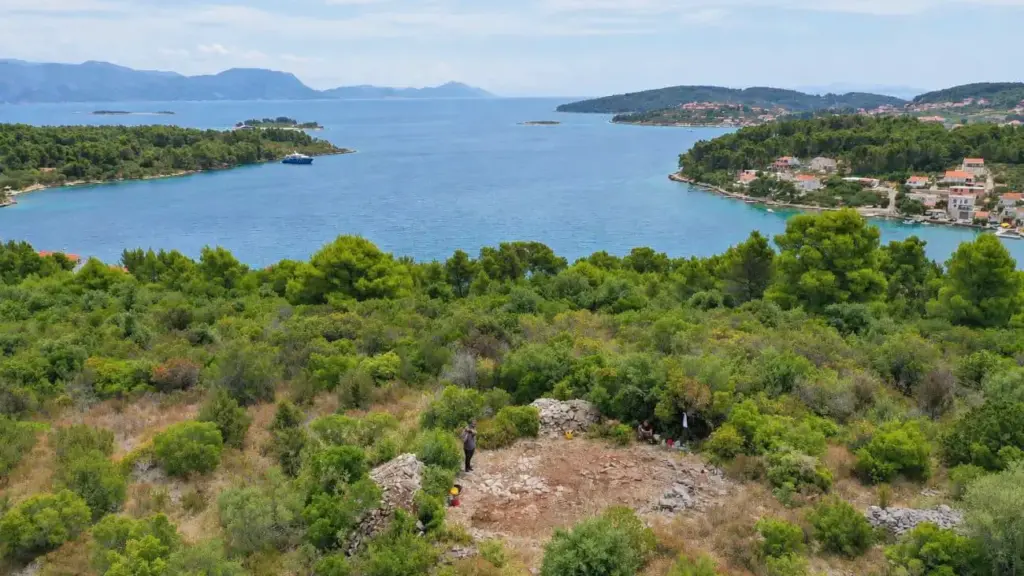
In 2026, research was not limited to just shovels and trowels. Through systematic field surveys and the analysis of aerial photographs, the number of known prehistoric stone mounds in Lumbarda rose from an original six to 15 preserved mounds today —and if we add two more that were still visible in historical photographs, but have since disappeared, the total even reaches 17 sites.
| Find Area / Project Component | Time Period | Key Findings & Discoveries in 2026 |
| Javič (Mounds J3 & J1) | Dating pending | Stone burial chest measuring 67 × 132 cm containing human bones and pottery; evidence of a lost grave near J1 |
| Krmača | Bronze Age (ca. 15th century BCE) | Excavation completed in 2016; multi-phase burial mound, bones, pottery, and shells; C-14 and isotope analyses planned |
| Koludrt (Land & Sea) | Hellenistic (ca. 3rd century B.C.) | Numerous Greek pottery fragments, possible floor layer, ancient loom weight recovered from the sea |
| Entire Lumbarda area | Prehistoric to Ancient | 15 preserved (out of a total of 17 documented) stone mounds mapped; LiDAR data acquired for non-destructive exploration |
The location of the mounds is striking: while some line the edges of fertile depressions such as Donje blato, Gornje blato, and Mindel, others are perched on hills offering sweeping views over fields, ancient trade routes, and waterways. Two mounds in the Gornje blato area and one south of Vela straža have already been selected for future investigations. With the help of newly acquired LiDAR data covering the entire municipal area, even the finest terrain features can be detected in the future—even beneath dense vegetation—without any immediate disturbance to the ground.
Outlook for 2027—and an Urgent Call for Heritage Preservation
The work carried out as part of the “Archaeological Heritage of Lumbarda” project —supported by the Bašćina Lumbarda Association in partnership with Lipa Rič Lumbarda, the Universities of Zadar and Zagreb, and the Lumbarda Tourism Board, under the project leadership of Fani Kršinić and co-financed by the Ministry of Regional Development and EU funds —will resume as early as the beginning of 2027.
Why heritage preservation matters here: The 2026 campaign has not only brought spectacular discoveries to light but has also shown just how vulnerable this heritage is. Trash, slash-and-burn farming, stone theft, and construction work have destroyed irreplaceable traces over the decades. This makes on-site research and the knowledge of local residents all the more important, as their memories often provide researchers with the crucial clue.
Lumbarda is piecing together its historical puzzle bit by bit—from the Bronze Age communities of 3,500 years ago to the Greek sailors and settlers of antiquity. And everything points to the fact that, starting in 2027, the excavations will uncover many more secrets hidden beneath the stones, olive trees, and waves of Korčula.