Stay up to date – you can subscribe to our newsletter here

For most travelers, Supetar is just a quick stopover. As soon as the ramp of the Jadrolinija ferry from Split lowers, cars and buses quickly roll out of the port—toward Bol, the Golden Horn, or further inland. But those in such a hurry miss out on one of the most charming small towns in Central Dalmatia. Supetar is not only the administrative and economic center of Brač, but also a lively island town year-round, with a relaxed pace, a rich history carved in white limestone, and easy access to the water.
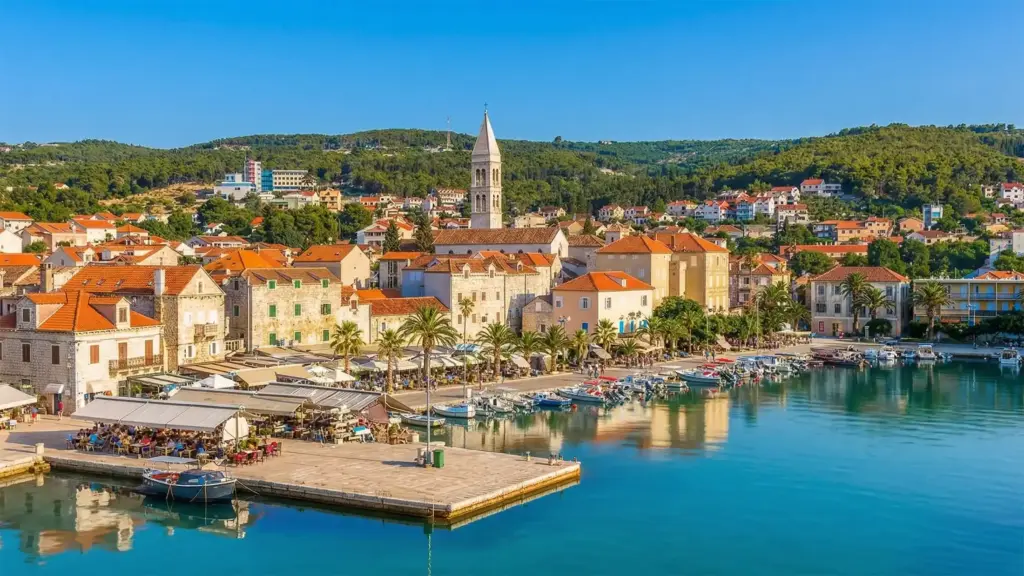
The horseshoe-shaped port and life along the Riva
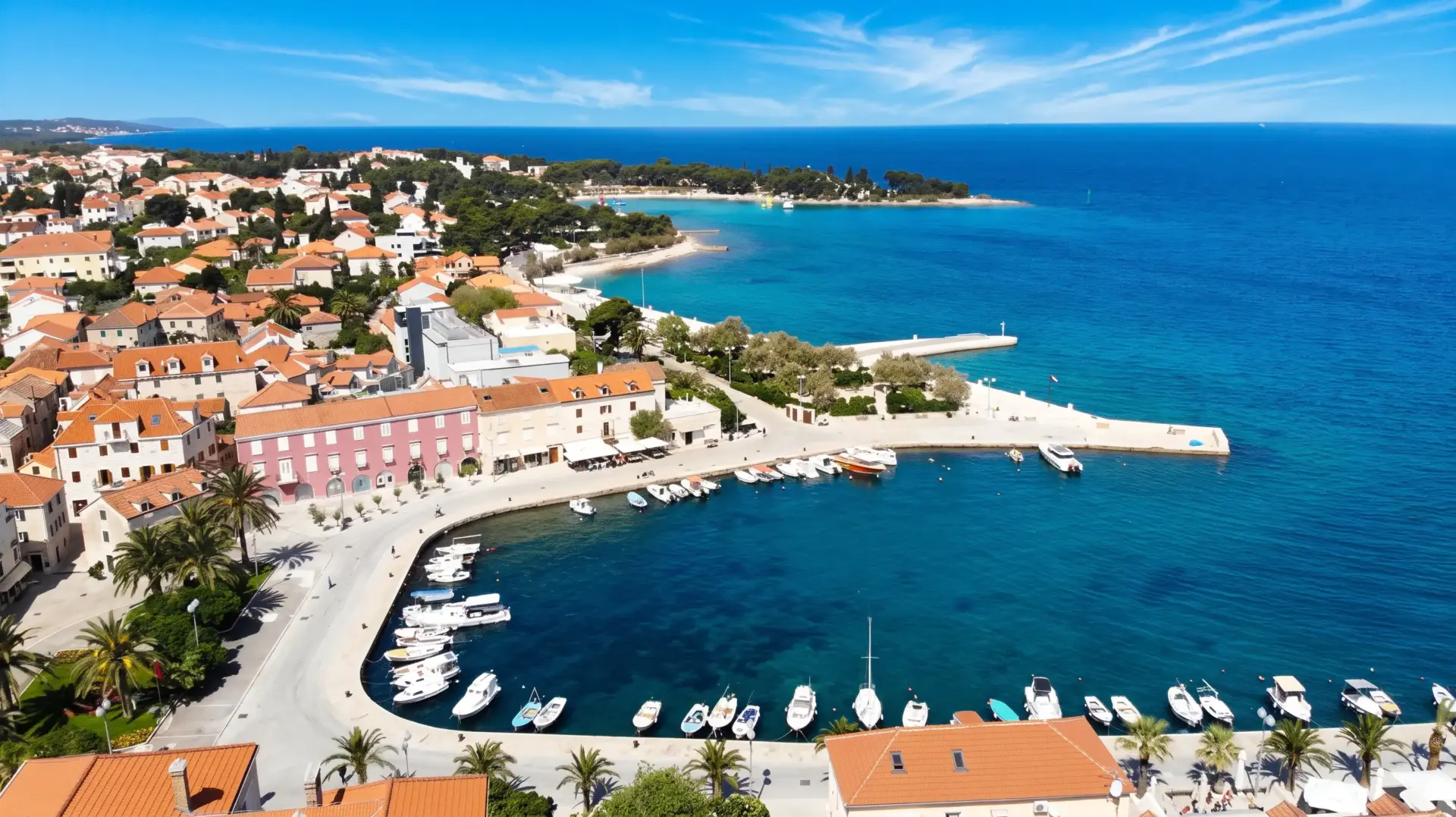
The heart of Supetar beats around the curved harbor bay. While ferries from Split arrive hourly at the outer ferry terminal in the summer—the crossing takes about 50 minutes—the inner town harbor is much quieter. Small fishing boats bob alongside excursion boats, with rows of stone houses featuring red-tiled roofs and green shutters lining the shore behind them.
The waterfront promenade (Riva) runs all the way around the bay. In the morning, locals sit here enjoying their first cup of coffee, picking up fresh bread, or running errands at the small market near the port. In the narrow alleys just behind the first row of houses, it immediately becomes quieter: clotheslines stretch between old walls, the scent of rosemary and figs wafts from the courtyards, and you quickly realize that Supetar isn’t just a vacation backdrop, but a thriving island town with about 4,000 residents.

Stone, Art, and History: What You Should See in Supetar
Brač is world-famous for its light-colored limestone—and Supetar showcases what can be created from it at every turn. All the major sights can be easily reached on foot in one to two hours:
- Parish Church of the Annunciation (Crkva Navještenja Marijina): It stands slightly elevated above the port, and its bell tower and the adjacent clock tower (Leroj) define the city’s skyline. Right next to the 18th-century Baroque church, early Christian floor mosaics from the 6th century have been preserved in the open air.
- Sveti Nikola Peninsula and the Petrinović Mausoleum: A walk along the western edge of the bay leads to the wooded Sveti Nikola Peninsula. There you’ll find not only the historic cemetery with its ornate tombs, but also the striking white mausoleum of the Petrinović family. Sculptor Toma Rosandić created the domed structure out of Brač stone in the 1920s—an extraordinary blend of Neo-Byzantine, Art Nouveau, and Dalmatian traditions.
- Traces of Ivan Rendić: One of the founders of modern Croatian sculpture grew up in Supetar. Original works and sketches are on display at the small Ivan Rendić Gallery in the town center; you’ll come across more of the artist’s sculptures as you stroll through the town and in the cemetery.
Beaches and swimming coves around the town
One of Supetar’s biggest advantages is its close proximity to the sea. You don’t need a car to get to the water—the coastline on both sides of the port consists of a series of small and large bays:
- Vlačica and Banj: Directly west of the city harbor lies the shallow bay of Vlačica, followed by Banj Beach. Both feature fine gravel, a sandy seabed in places, and crystal-clear, gently sloping waters—ideal for families or a quick morning swim.
- Acapulco and Vrilo: Further along the waterfront toward the east lie the pebble beaches of Vrilo and Acapulco, with views across to the mainland and the Mosor Mountains.
- Tri Mosta: A somewhat longer stretch of beach lined with pine trees that is lively in midsummer but also offers plenty of natural shade.
If you prefer a quieter setting, follow the coastal path a little further west toward Mirca or east to the picturesque neighboring village of Splitska —there you’ll find numerous small rocky and pebble coves away from the hustle and bustle.
Tips for Skippers and Boaters
Anyone approaching Supetar by water should realistically assess the port. The inner city port offers only a very limited number of guest berths for yachts and recreational boats; large sections are shared by locals, tour boats, and ferry operations. In addition, the bay is open to the north—when the Bora wind is strong, there is swell in the port, and the wake from the frequently passing ferries is also clearly noticeable. For a short day stop in calm weather to refuel or take a stroll through town, mooring is easily arranged by coordinating with the port staff. For a completely sheltered overnight stay, however, many skippers prefer to head to nearby Splitska, the deeply indented bay of Bobovišća, or the marina in Milna in the west of the island.
Culinary Experiences and Rewarding Excursions into the Island’s Interior
When it comes to culinary matters, Supetar is all about traditional Brač fare. In addition to freshly caught fish and seafood along the Riva, it’s worth checking out the specialties from the island’s interior: tender Brač lamb (on a skewer or baked under a peka), the sweet, caramelized young cheese called Procip, robust cold-pressed olive oil from the native Oblica variety, and a glass of dark Plavac Mali. Good konobas are often tucked away in an alley off the main promenade—or just a few meters higher up in the old stone villages.
Thanks to its central location on the north coast, Supetar is an excellent starting point for exploring the entire island:
- Škrip (about 10 km): The oldest village on Brač captivates visitors with its Illyrian walls, the Island Museum, and the outstanding Olive Oil Museum (Muzej uja), where you can experience the history of olive oil production up close and sample local products.
- Vidova Gora (approx. 20 km): At 778 meters, it is the highest peak of all the Adriatic islands. From the top, a spectacular view opens up down toward Bol, the Golden Horn, and all the way to Hvar, Korčula, and Vis.
- Blaca Hermitage (Pustinja Blaca): Built into a steep cliff face by monks in the 16th century, the monastery is tucked away in the southwest of the island and can only be reached via a roughly 45-minute hike—one of the most impressive places in Dalmatia.
Supetar is at its most authentic outside the peak season—in May, June, September, and October. That’s when the beaches empty out, the temperatures remain pleasantly warm, and the Riva takes on that laid-back Dalmatian “pomalo” vibe —which makes it worth spending not just a quick stopover, but a few real days on Brač.