Stay up to date – you can subscribe to our newsletter here

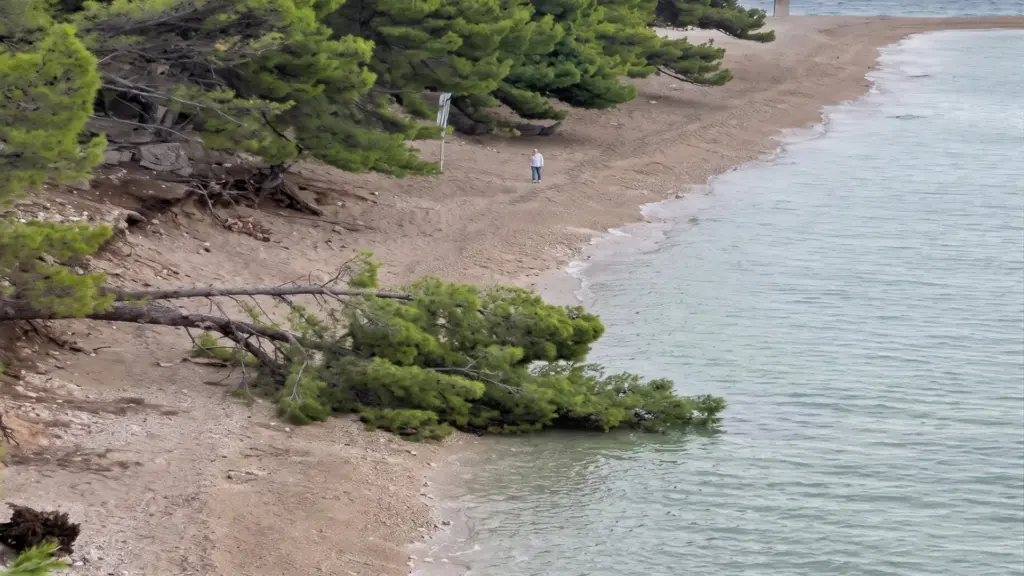
It is arguably the most photographed postcard scene in the entire Adriatic—and at the same time a case study in how Croatia often treats its endangered natural treasures. While on the western side of the famous Zlatni Rat beach in Bol on the island of Brač, the gravel is disappearing and old pine trees, their roots eroded, are already tumbling into the sea, the public nature conservation agency More i krš has now presented its response:
a call for proposals worth 395,000 euros net (nearly half a million euros including Croatian VAT) for a two-year monitoring project.
First, the good news: Scientific data is useful. The bad news: Not a single euro of this amount is being spent on immediate protective measures, inspections, or addressing problems that have long been known.
The aerial photograph immediately reveals the unique dynamics of the area: the narrow gravel spit, with a dense pine forest at its center, thrives on the delicate balance of currents, wind, and the surrounding shallow water zones. However, deep signs of erosion are now evident precisely at the transitions between the beach and the tree line.
What is actually being put out to bid—and how much time is being lost
A closer look at the call for proposals published on November 16, 2026, reveals what it’s all about: Under the title “Monitoring and Analysis of the Beach Accumulation Process (dohrana plaže),” waves, ocean currents, sediment movements, and environmental processes are to be measured over a 24-month period and incorporated into predictive models.
The problem here is the time factor:
- Bid deadline: Bidders have until December 23, 2026, to submit their bids.
- Delays are inevitable: After the bids are reviewed, the contract is awarded, and any potential appeals are resolved, the project is unlikely to actually begin until spring or summer 2027 at the earliest.
- Results not expecteduntil 2029 at the earliest: Given the two-year project duration, reliable models and recommendations for action will not be available until 2029 at the earliest.
How many more trees will slide down the western slope—which is exposed to the Maestral—by then is another matter entirely.

The elephant in the room: problems for which no one needs a 400,000-euro model
Zlatni Rat Beach has been protected as a significant landscape (značajni krajobraz) since 1965, and its seabed is part of the European Natura 2000 network of protected areas. On paper, then, the Golden Horn has been well protected for over six decades. In reality, however, the situation along the waterfront looks quite different—and the reasons for this are by no means an unsolved scientific mystery:
- Uncontrolled anchoring destroys seagrass: Off the coast of Zlatni Rat lie sensitivePosidonia oceanica meadows. They are far more than just a habitat for fish—they dampen wave energy and stabilize the sediment on the seafloor. Environmental organizations such as Udruga Sunce sounded the alarm as early as the summer of 2024, and even the official anchorage plan for Split-Dalmatia County from that same year documented the massive nautical pressure and the increasingly uncontrolled anchoring directly off the beach.
- Laws exist, but enforcement is lacking: Under Croatian law, anchoring within 150 meters of a natural beach is prohibited anyway. Yet residents and environmentalists have been complaining for years that these rules are simply not enforced during the high season. Anyone observing the bay in July or August doesn’t need oceanographic sensors to see the effects of anchor chains and propeller wash.
- Human interference and mass tourism: As early as the fall of 2024, frustrated residents launched a petition against the excesses of mass tourism and boat traffic around the beach. At the same time, discussions in the Bol City Council about surrounding coastal construction projects—such as the expansion of the Port of Bol—repeatedly raise the question of how much concrete and breakwaters have already diverted the natural currents.
Critical objection: You don’t have to be an oceanographer to ask a straightforward question: Why invest nearly half a million euros in computer models when you aren’t even capable or willing to effectively enforce the current ban on anchoring?
Science as a Convenient Excuse?
To be fair, one thing must be noted: In principle, there is nothing wrong with well-founded research. On the contrary—ill-considered, hasty beach replenishment projects using unsuitable dredged gravel have already caused enough damage along the Croatian coast. A dynamic geomorphological phenomenon like the Golden Horn is highly sensitive to human intervention, climate change, and shifting storm patterns. Long-term data is therefore indeed important for avoiding future mistakes.
Such a project only becomes cause for concern when the monitoring serves as a political fig leaf. From the perspective of government agencies and local politicians, a two-year tender process has one unbeatable advantage: it signals a willingness to take action (“major environmental project”) without having to confront the tourism and boating industries in the short term. Strict controls at sea, hefty penalties for illegal anchoring, or genuine visitor management would immediately trigger protests. An expert report, on the other hand, doesn’t hurt anyone—except the taxpayer and, in the end, perhaps the beach itself.

The crucial question: transparency or a paper drawer?
Added to this is a chronic problem with large-scale Croatian studies: the lack of public access. The central question already being raised is whether the measured data, the exact locations of the measuring devices, and the ongoing interim results will be made transparently accessible to citizens, local initiatives, and the media—or whether, at the end of the 24 months, yet another expensive final report will gather dust in some government drawer.
The Golden Horn hasn’t just started changing yesterday, and it certainly won’t wait patiently until 2029 for the results of a predictive model. If More i krš, Split-Dalmatia County, and the municipality of Bol truly want to save Brač’s landmark, the 395,000 euros allocated for monitoring can only be the second step. The first step would be significantly less expensive and immediately implementable: clearly defined protection zones for the Posidonia meadows, consistent on-the-water inspections by port authorities, and the political courage to finally prioritize nature conservation over unchecked summer tourism once again.