Stay up to date – you can subscribe to our newsletter here

Crystal-clear seawater is the Croatian coast’s most valuable asset—and at the same time the most sensitive test of the country’s municipal infrastructure. On November 19, 2026, the European Commission launched formal infringement proceedings against Croatia (Case INFR(2026)2171). Based on Croatian reporting data from 2024, 60 urban areas nationwide with more than 10,000 residents still do not meet the requirements of the EU Urban Wastewater Treatment Directive (91/271/EEC).
While some of the locations in question are located inland, the criticism from Brussels is directed in particular at the major tourist centers and port cities from Istria to Southern Dalmatia. According to the EU Accession Treaty, Croatia should have ensured the complete collection and proper treatment of wastewater in all major urban areas by the end of 2018 and 2020, respectively.
What Brussels is criticizing—and why the coast faces particular challenges
The Commission’s warning letter shares the 60 affected urban areas into two problem groups:
- 23 metropolitan areas lack both proper collection and adequate treatment of municipal wastewater.
- 37 metropolitan areas do collect wastewater, but discharge it into rivers or the sea without the required level of treatment.
- In 40 of the 60 cases, inadequately treated wastewater flows into so-called sensitive areas, for which stricter legal limits apply.
On the Adriatic coast, this shortcoming weighs doubly heavily. For decades, many coastal cities relied solely on mechanical pretreatment (a first stage using coarse screens) and discharged the wastewater far out into the sea via long underwater pipes. In enclosed bays, densely populated coastal areas, and sensitive marine zones, this model is no longer sufficient under EU law—at least a second (biological) treatment stage is required. Added to this is the porous karst subsoil along the coast, through which leaky septic tanks in areas without sewer systems can directly contaminate the groundwater and nearby bays.
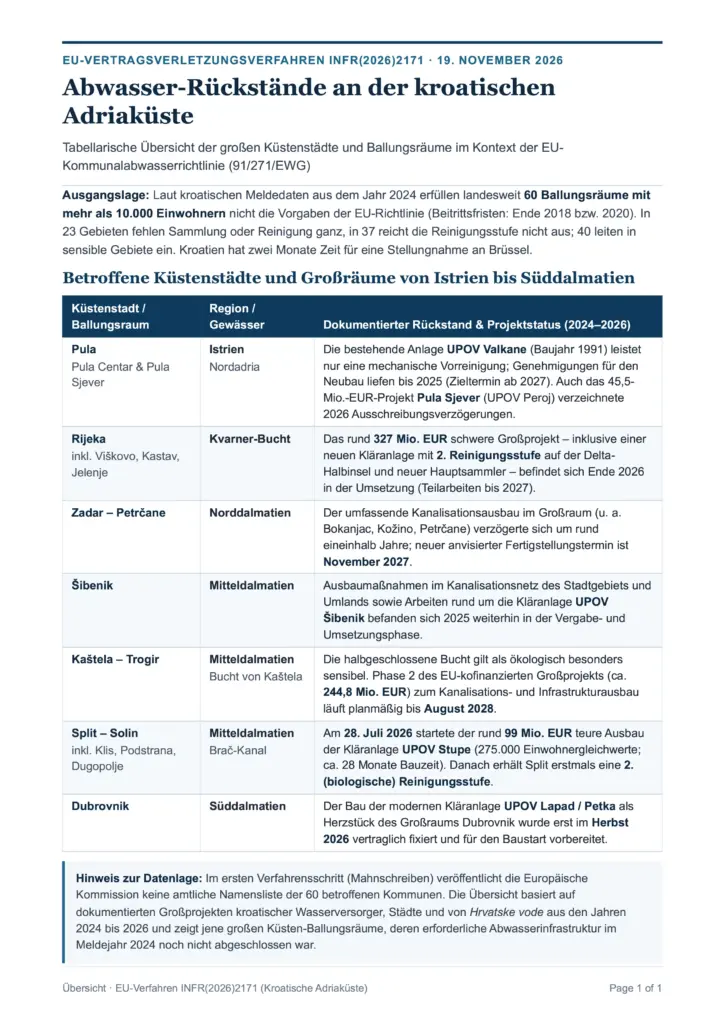
Regarding the data: In the first stage of the process, the European Commission does not publish an official list of the 60 municipalities. However, based on the documented major projects of Croatian water utilities, cities, and Hrvatske vode from 2024 to 2026, it is clear which major coastal cities and metropolitan areas did not yet have the required wastewater infrastructure in the relevant reporting year of 2024.

From Istria to Southern Dalmatia: An Overview of the Major Coastal Cities and Metropolitan Areas
Although EU development projects worth hundreds of millions of euros are currently underway in nearly all major centers along the Adriatic, they had not yet been completed by 2024, the reference year for Brussels.
Why Development Along the Coast Is Stalling
The fact that, of all places, economically strong tourism regions with substantial EU funding have fallen years behind is primarily due to factors specific to coastal areas:
- Seasonal construction halts: In tourist destinations such as Zadar, Split, Pula, and Dubrovnik, major excavation and sewer construction projects are put on hold during the summer months. Projects that take two years to complete inland often stretch over four to five seasons along the coast.
- Extreme summer peak loads: Between June and September, the actual population in many coastal communities increases significantly. Facilities must be designed to handle these short, extreme peak loads, which drives up planning and construction costs.
- Delays in awarding contracts and contract amendments: Contested bids, missing building permits, and numerous contract amendments have repeatedly set major projects—such as those in Pula and Zadar—back by years.
- Deteriorating Existing Networks: Since Croatia experiences water losses of about 50 percent in its drinking water network nationwide, many coastal cities are simultaneously replacing drinking water and wastewater pipes as part of major infrastructure projects—a technically and logistically complex dual construction project.
Two-month deadline—and stricter rules on the horizon
Croatia is not yet facing immediate fines as a result of the warning letter. Zagreb now has two months to submit to the Commission binding construction progress reports and timelines for the 60 affected urban areas—otherwise, the next step in the escalation process will be a reasoned opinion from Brussels. At the same time, pressure is set to increase further in the long term: The EU Urban Wastewater Treatment Directive, which will be reformed by the end of 2024, will significantly tighten the requirements in the coming years and gradually lower the threshold for mandatory compliance from 2,000 to 1,000 residents. By then at the latest, not only the major port cities but also numerous smaller coastal towns and island communities along the Adriatic Sea will have to comply.