Stay up to date – you can subscribe to our newsletter here
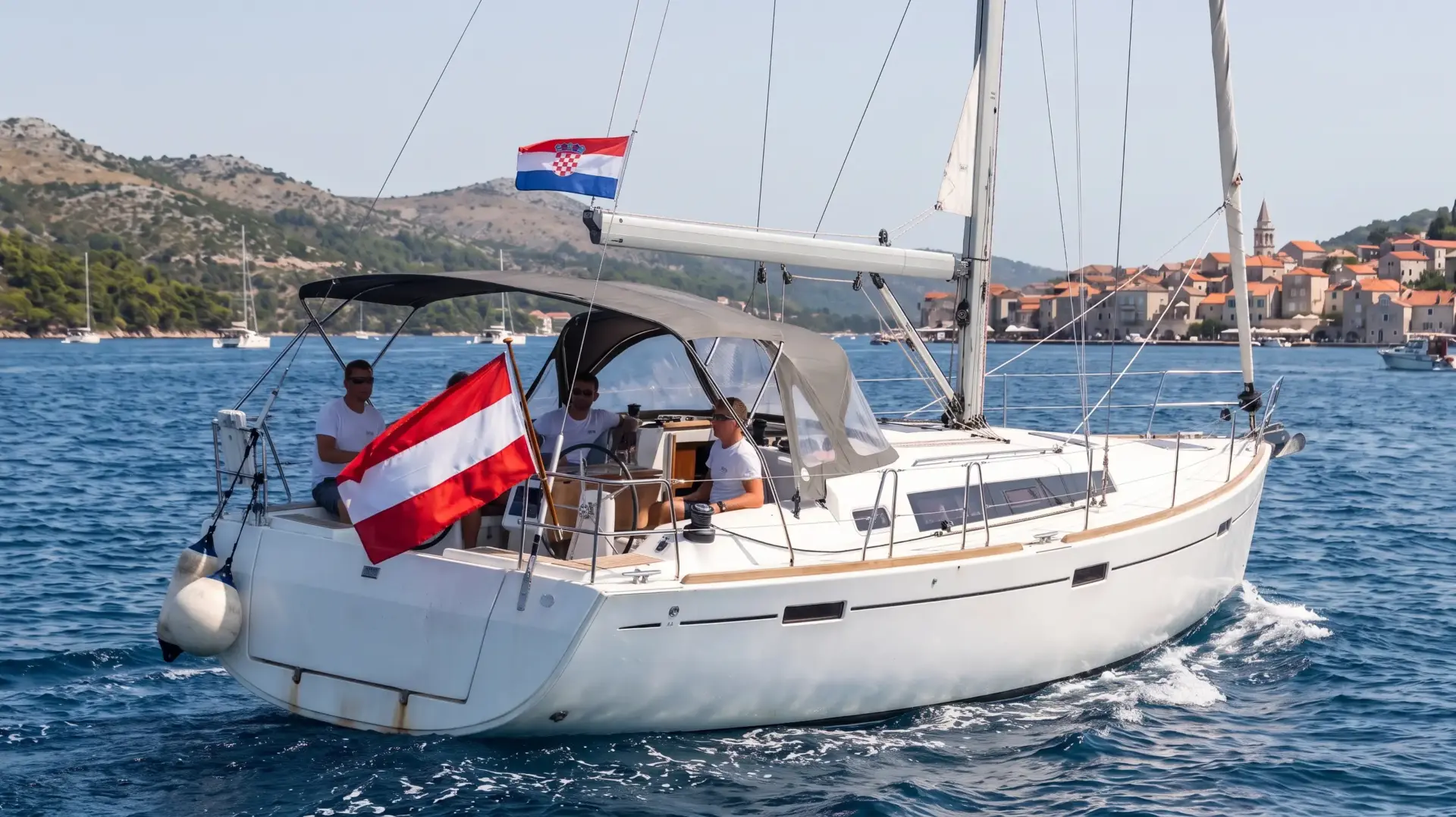
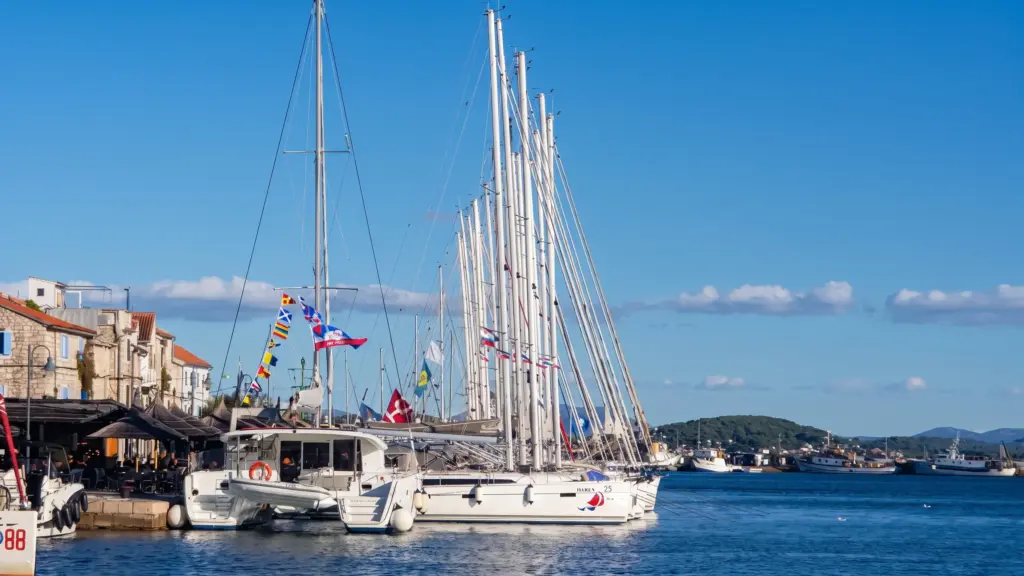
A stroll along the docks of a Croatian marina is enough to witness what is probably the most colorful misunderstanding in the Mediterranean: On one yacht, the German flag flies below the port shroud; on the neighboring boat, the Austrian flag flutters on the starboard side above the Croatian one; and on the third boat, a frayed pennant hangs at half-mast.
Yet maritime flag etiquette is not some outdated relic, but rather maritime law in practice—even if, in Croatia, the harbour masters (Lučka kapetanija) and the coast guard often turn a blind eye!
Before we look at specific cases and an interesting legal exception for smaller boats under 12 meters, it’s important to understand the most important principle of the flag parade:
The national flag always reflects the boat (the country of registration), never the skipper’s nationality!
The 3 seats on board: Where does everything go?
- The stern (or backstay): This is the place of honor on board. Only the national flag of the country in which the boat is officially registered is flown here. On motorboats without a mast, it is mounted on the stern flagpole or on the equipment rack (often slightly offset to starboard if the gangway is centered).
- The starboard halyard (on the right when facing the direction of travel): The second most important position. This is where the flag of the host country is hoisted—that is, the flag of the country whose territorial waters you are currently in. On motorboats without a mast, it belongs on the starboard side of the equipment rack, on the bimini, or on the bow flagpole.
- The port side (left when facing forward): This is where club pennants (yacht club), association flags, and owner’s or family pennants are flown. An official national flag has no place here!

1. Boat registered in Germany or Austria.
This is the classic scenario for boat owners who sail to Croatia under their own power or bring their boat to Croatia on a trailer.
- At the stern (national flag): The flag of the country that issued the vessel certificate, the certificate of registry, or the International Boat Certificate (IBS) is flown. If the boat is registered in Austria, the red-white-red flag flies at the stern (without the federal eagle, as this is reserved for government authorities). If the boat is registered in Germany, the black-red-gold flag flies at the stern. (An interesting side note: If an Austrian skipper is operating a boat registered in Germany, the German flag must still fly at the stern!)
- On the starboard side (host country flag): As soon as you enter Croatian territorial waters (or launch the boat in Croatia), hoist the Croatian flag here as the host country flag. It is significantly smaller than the national flag at the stern.
- On the port side: Optionally, your yacht club pennant.
- Important for small trailer boats: According to the Croatian Maritime Code (Pomorski zakonik, Art. 66/67), foreign boats —regardless of their size (including those under 8 meters in length)—are strictly required to fly both their home flag and the Croatian guest country flag in Croatian waters.
2. Boat registered in Croatia (charter).
In practice, 90 percent of all errors occur here. When you take delivery of a charter yacht or a recreational boat on the Adriatic, that vessel is almost always registered in Croatia.
- At the stern (national flag): The Croatian flag is flying! Since the boat is registered in Croatia, Croatia is the boat’s flag state.
- Under the starboard spreader (host country flag): This spot remains empty! A Croatian boat is at home in Croatia—it is not a guest there. Hoisting a second Croatian flag under the spreader is redundant and a violation of maritime practice. (Only when you sail the Croatian charter yacht to Italy or Montenegro, for example, do you hoist the Italian or Montenegrin guest country flag there.)
- Under the port side spinnaker (the famous “charter trap”): Whether out of pride or to greet fellow countrymen in the bay, countless German and Austrian charter crews hoist their own national flag on the port side or on the bimini. According to flag etiquette and maritime law, this is incorrect. A national flag is a symbol of sovereignty used to identify a vessel, not a “fan pennant” for the crew.
- The neat solution: If you want to show where your crew is from, fly a club pennant, a city or state flag (e.g., Bavaria, Vienna, Styria—in each case without the official state coat of arms) on the port side, or simply fly the charter base’s pennant.
Special Case Under the Law: Does a Croatian boat under 12 meters even have to fly a flag?
Anyone who operates or charters a smaller motorboat registered in Croatia will come across an interesting detail in the Croatian Maritime Code (Pomorski zakonik, Art. 180). The law sets the threshold at 12 meters and distinguishes between yachts (Jahte, 12 meters and longer) and boats/small vessels (Brodice, under 12 meters):
- From a strictly legal standpoint, there is no requirement in home waters: A brodica registered in Croatia (i.e., any boat under 12 meters) is already clearly identified as a Croatian vessel within Croatian territorial waters by its registration number affixed to the bow (oznaka brodice, e.g.,
ŠI 1234orZD 1234). By law, a domestic brodica is not required to fly the Croatian flag until it leaves Croatian territorial waters. - Two important points to note here:
- If you decide to fly the Croatian flag on a Brodica, it must strictly comply with the regulations (clean, undamaged, and not faded).
- The legal exemption is not a free pass for foreign flags: A German or Austrian charter skipper may under no circumstances fly the German or Austrian national flag on a Croatian 7-meter boat instead!
3. Boat registered outside the EU.
It is becoming increasingly common to see boats in the Adriatic flying the Swiss flag, the British Red Ensign (UK), U.S. registration (e.g., Delaware), or Montenegrin registration, operated by non-EU citizens. In addition to etiquette, customs and border laws also come into play here.
- At the stern (national flag): The maritime flag of the respective non-EU country of registration is flying (e.g., the Swiss maritime flag, the UK flag, or the US flag).
- Under the starboard shroud (entry flag & host country flag):
- When entering by sea (clearance): Anyone entering Croatian territorial waters from international waters or a third country must proceed directly to the nearest official customs port (Port of Entry, e.g., Cavtat, Dubrovnik, Zadar, Umag). The Croatian host country flag must be flown at the top on the starboard side, with the yellow signal flag “Q” (Quebec) —the international customs flag (“My ship is in good standing; I request permission to proceed”)—displayed directly below it.
- After clearing customs: As soon as the police, customs officials, and the harbour master have stamped the papers, registered the crew list, and collected the fees (vignette, tourist tax), the yellow “Q” flag is lowered. The Croatian guest flag remains hoisted on the starboard side throughout the entire stay.
- Important customs information (18-month rule): Since EU VAT is generally not paid for such a boat, it falls under the Temporary Admission procedure in Croatia (EU customs territory). Because both the boat is registered outside the EU and the skipper/owner resides outside the EU, the boat may remain in EU waters tax- and duty-free for up to 18 months . After this period, it must temporarily leave EU waters (and this must be officially proven by clearing out).
All Cases at a Glance
| Scenario | Aft (National) | Starboard (Host Country) | Port | Special Features & Laws |
| 1. Boat DE/AT, skipper DE/AT | Flag of the country of registration (DE or AT) | Croatian flag | Club flag / blank | This requirement applies to boats of all sizes (including those under 8 m); the stern flag is determined by the boat’s registration documents |
| 2a. Boat HR (charter boats 12 m and longer / yachts), skipper DE/AT | Croatian flag (required) | Blank (within Croatia) | Club flag / regional flag (no DE/AT national flags!) | Croatia is the boat’s home country, so a host country flag is not required |
| 2b. Boat HR (under 12 m / Brodica), skipper DE/AT | Croatian flag (legally optional, as per the Charter Standard) | Blank (within Croatia) | Club flag / regional flag (no DE/AT national flags!) | Identified by bow number (oznaka); the flag must be flown only when leaving Croatian waters |
| 3. Non-EU boat, non-EU skipper | Flag of the non-EU country of registration | Croatian flag (+ yellow “Q” flag until clearing customs) | Club flag / blank | Required to clear customs immediately at the port of entry; observe the 18-month customs rule |
3 Practical Tips for a Sailing Trip in Croatia
- Do not display tattered flags: In Croatia, flying a faded, torn, or frayed flag is considered a sign of disrespect for state symbols and can result in a hefty penalty. Flags suffer a great deal from the wind, especially on fast motorboats—be sure to replace them in a timely manner.
- Make sure the flags are the correct size: The national flag at the stern is always the largest flag on board (rule of thumb: approximately 10 cm of flag length per meter of ship’s length). The host country’s flag on the starboard side must be significantly smaller.
- Traditional Flag Parade: According to good seamanship, flags are hoisted in the port at sunrise (no earlier than 8:00 a.m.) and lowered again at sunset (no later than 9:00 p.m.). At sea, they may fly day and night—in modern recreational boating, they are usually left hoisted continuously during a vacation, but on traditional sailing vessels in port, you’ll earn major brownie points if you lower them in the evening.